
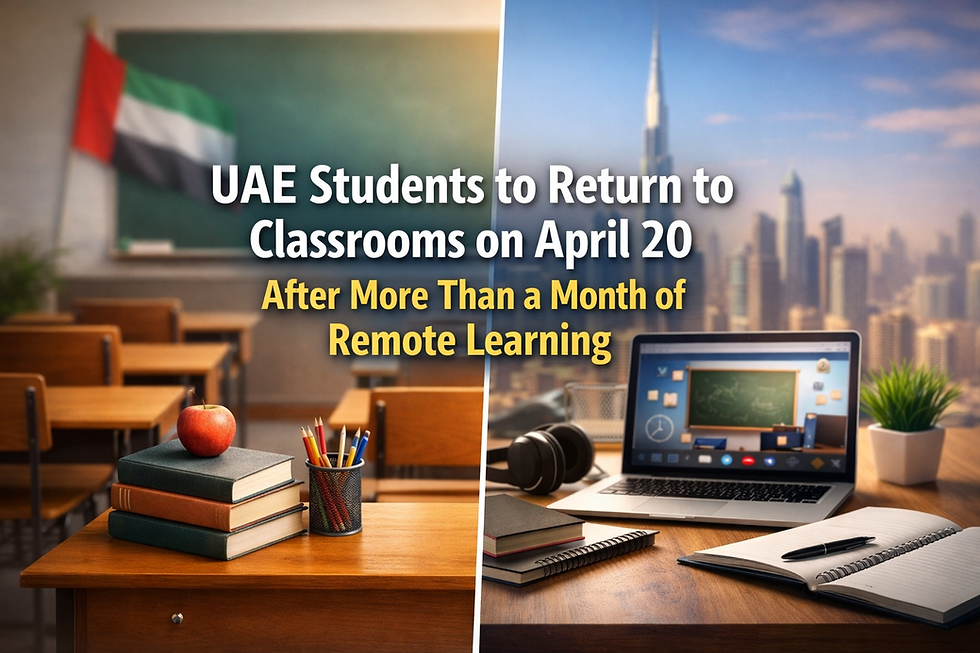
UAE Students to Return to Classrooms on April 20 After More Than a Month of Remote Learning
After more than a month of distance education, students in the United Arab Emirates are set to return to classrooms on April 20. The decision marks an important step for the education sector and for families who have been adapting to remote learning for several weeks. It is also a strong sign that the system has remained active, flexible, and focused on continuity during a challenging period.
What stands out most is not only the return itself, but how education continued during the remote phase. Across the country, learning did not stop. Lessons moved online, teachers adjusted quickly, and students continued their studies from home. In many cases, this period showed that distance education is no longer just an emergency option. It has become a real part of modern education, capable of supporting students when normal classroom routines are interrupted.
The move back to in-person learning is being welcomed positively because it combines two important ideas: stability and progress. Classrooms offer structure, social interaction, and direct engagement between teachers and students. At the same time, the recent weeks of online education have shown that digital tools can strengthen learning when used well. This means the return to campus is not a return to the old way only. It may also be the beginning of a more balanced and flexible model of education in the future.
One of the most encouraging results of the remote learning period is the improvement in digital readiness. Many students became more confident in using online platforms, submitting assignments electronically, attending virtual lessons, and managing their schedules more independently. Teachers also gained more experience with digital teaching methods, interactive presentations, and online assessment tools. These are useful skills that will continue to support education even after students are back in physical classrooms.
Another positive point is that the recent experience may help improve the overall quality of education. When schools and education providers are able to work both online and in person, they become more resilient. They can respond faster to change, support different student needs, and use more than one teaching method. Some students perform better when they have access to recorded materials, digital notes, and flexible review options. Others benefit more from direct classroom discussion. A system that can offer both is often stronger than one that depends on only one format.
Families have also played an important role during this period. Parents and guardians became more directly involved in daily study routines, and many gained a closer view of how students learn. This stronger connection between home and education can have a lasting positive effect. When families better understand student needs, they are often better able to support academic progress in the long term.
The return to classrooms also matters for student wellbeing. Remote learning can be effective, but many students miss the social side of education. Being back in a learning environment with classmates, teachers, routines, and shared activities can support motivation and emotional balance. For younger learners especially, the classroom experience remains an important part of development. For older students, face-to-face discussion, practical sessions, and academic structure can improve focus and engagement.
At the same time, the remote learning period should not be seen as lost time. On the contrary, it offered a real test of how modern education can continue under pressure. The fact that students are now returning after more than a month of online learning shows that the system was able to hold together and prepare for the next step. That is a positive message for the future of education in the UAE.
This development also sends a wider message about distance education itself. It shows that online learning, when well organized, can protect continuity and reduce disruption. It may not replace the classroom, but it can support it in powerful ways. In the future, education models that blend physical attendance with smart digital tools may become even more common.
As April 20 approaches, the return to classrooms represents more than a reopening. It reflects adaptation, commitment, and the growing strength of flexible education. Students are going back to class, but they are also bringing with them new digital habits, new learning skills, and a stronger understanding of how education can continue under different conditions. That is good news not only for this week, but for the future of learning in the UAE.


Comments