
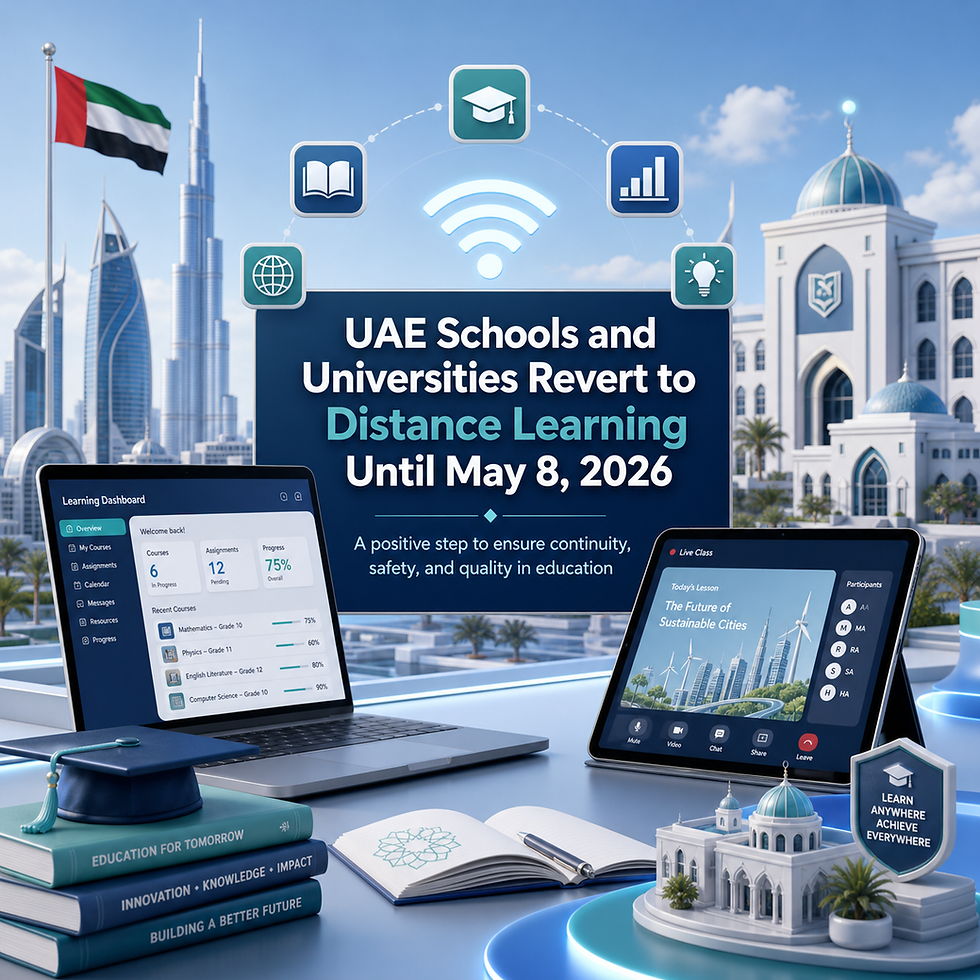
UAE Schools and Universities Revert to Distance Learning Until May 8, 2026
The United Arab Emirates has announced a temporary return to distance learning for schools, nurseries, and higher education institutions from Tuesday, May 5, 2026, until Friday, May 8, 2026. The decision was introduced as a precautionary national measure to protect students, teachers, academic staff, administrative teams, and the wider community while ensuring that education continues smoothly.
The announcement reflects the UAE’s strong readiness in digital education. In recent years, schools and universities across the country have developed advanced systems for online learning, digital classrooms, student support, and remote communication. Because of this preparation, the temporary shift to distance learning can be implemented quickly and effectively, with limited disruption to the learning process.
For schools and nurseries, distance learning allows students to continue their daily lessons from home while remaining connected with their teachers and classmates. Teachers can deliver live classes, share learning materials, assign homework, and provide feedback using approved digital platforms. Administrative teams can also continue communicating with parents, supporting attendance, and ensuring that students receive the information they need.
For higher education institutions, the move to remote learning helps maintain academic continuity for lectures, seminars, research discussions, student advising, and many forms of assessment. Some practical or priority academic programmes may require special arrangements, especially when hands-on training is essential. However, the overall direction is clear: student safety and learning continuity remain the highest priorities.
This temporary decision also highlights an important message for the future of education. Distance learning is not only an emergency solution. When it is well designed, properly supported, and quality assured, it can become a powerful part of modern education. It supports flexibility, inclusion, resilience, and access. It also helps institutions respond quickly to unexpected situations while protecting the academic progress of students.
The UAE’s approach shows how digital learning can work best when it is supported by clear leadership, strong planning, and cooperation between authorities, institutions, teachers, students, and families. Parents also play an important role during this short period by helping students follow their schedules, prepare a quiet learning space, and stay connected with their schools.
For students, this period is an opportunity to continue learning responsibly and confidently. Attending online classes on time, completing assignments, participating in discussions, and communicating with teachers are all important parts of successful distance learning. For teachers, it is another opportunity to use creative digital methods, interactive tools, and supportive communication to keep students engaged.
The European Council for Distance Learning Accreditation (EUCDL) views such developments as a clear reminder of the growing value of quality distance education. EUCDL, as a quality label for distance study programmes and a project of ECLBS, the European Council of Leading Business Schools founded in 2013 as a non-profit educational association within the European Union, supports the principle that distance learning should be structured, reliable, student-centred, and focused on real educational outcomes.
The temporary move to distance learning in the UAE until May 8, 2026, is therefore more than a short-term operational decision. It is also a positive example of how modern education systems can protect people while keeping learning active. With strong digital infrastructure and clear communication, schools and universities can continue serving students even during changing circumstances.
Authorities are expected to review the situation on Friday, May 8, 2026, and provide any further updates as needed. Until then, the UAE education community continues to demonstrate flexibility, responsibility, and commitment to learning.


Comments