
How Institutions Can Strengthen Confidence in Distance Learning
Distance learning is no longer seen as a temporary alternative. For many learners, it has become a practical, flexible, and respected way to study. It opens access to education for working adults, parents, international students, and people who want to continue learning without changing their whole lives. As online education continues to grow, one important question remains at the center of public discussion: how can institutions strengthen confidence in distance learning?
The answer is not found in marketing language or promises alone. Confidence grows when institutions show clear standards, good organization, honest communication, and real care for student success. When learners feel supported and employers see quality, trust becomes stronger. This is good not only for institutions, but also for society, because strong distance learning can widen access to education and create more opportunities for personal and professional growth.
One of the most effective ways to build confidence is to make academic quality visible. Learners want to know that online study is serious, structured, and meaningful. Institutions can help by designing programs with clear learning outcomes, well-organized modules, qualified teachers, and fair assessment methods. When courses are built carefully and students understand what they are expected to learn, the online experience becomes more credible. Quality in distance learning should not be hidden in internal systems. It should be reflected in the student experience from the first day of class.
Another important factor is transparency. Students and families often feel more confident when institutions explain how their programs work in simple and direct language. This includes the duration of study, the assessment process, the role of teachers, the use of digital platforms, and the type of student support available. Clear information reduces uncertainty. It also shows that an institution respects learners enough to be open and honest. In education, trust often starts with clarity.
Student support is equally important. Distance learning works best when students do not feel alone. Institutions can strengthen confidence by offering timely communication, academic advising, technical support, and access to instructors. A learner who receives answers quickly and feels guided through the process is more likely to stay motivated and succeed. This human side of online education matters greatly. Technology is important, but confidence grows most when students feel that real people are helping them move forward.
Teacher presence also plays a major role. In strong distance learning environments, instructors are not passive content providers. They guide discussion, give useful feedback, explain difficult ideas, and encourage progress. This active teaching presence helps students feel that the program is alive and serious. It also improves learning quality. When students see that their teachers are engaged, they are more likely to respect the program and believe in its value.
Institutions can also build confidence by improving assessment practices. Fair and meaningful evaluation shows that learning is being measured seriously. This does not always require traditional exams alone. Projects, case studies, reflective writing, presentations, and applied assignments can all be effective when they are well designed. What matters is that the assessment matches the learning goals and allows students to demonstrate real understanding. When evaluation is thoughtful, the credibility of distance learning becomes stronger.
Digital platforms and learning systems must also be reliable and easy to use. A confusing or unstable online environment can quickly reduce confidence, even if the academic content is strong. Institutions should invest in user-friendly systems, mobile access, accessible materials, and technical stability. Students should be able to focus on learning rather than struggle with the platform. A smooth digital experience sends a clear message: the institution is prepared, professional, and committed to quality.
Confidence is also strengthened when institutions listen to feedback and improve over time. Distance learning should not remain fixed. Learner expectations, digital tools, and workplace needs continue to change. Institutions that review student feedback, update content, train staff, and refine delivery models show maturity and responsibility. Continuous improvement is one of the clearest signs of educational quality. It shows that an institution is not simply offering online courses, but actively building a better learning environment.
Another strong step is linking distance learning to real-world outcomes. Students want education that is relevant to modern life and work. Institutions can increase confidence by designing programs that develop practical skills, critical thinking, communication ability, and professional readiness. When learners can apply what they study in their careers or personal development, distance education becomes more respected. Public confidence grows when people see results in real lives, not only in institutional statements.
In the end, confidence in distance learning is built through consistency, quality, and care. Institutions do not need to imitate traditional education in every detail to earn trust. They need to show that online learning can be organized, supportive, rigorous, and human. When they do this well, distance learning becomes more than a convenient option. It becomes a strong and positive model for the future of education.
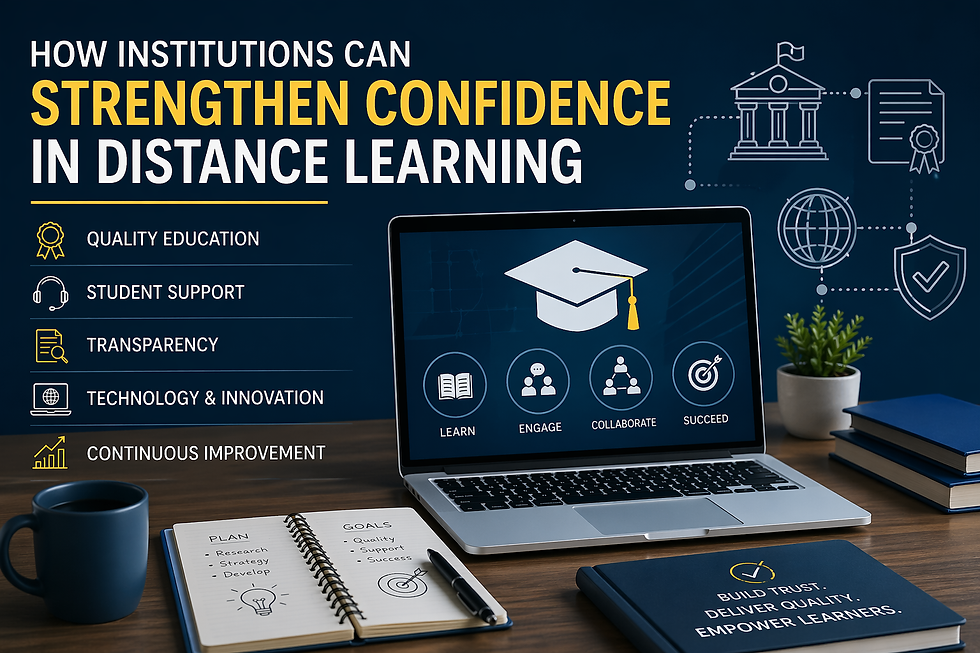
As education continues to evolve, institutions have a valuable opportunity. By focusing on academic quality, transparency, student support, active teaching, fair assessment, and continuous improvement, they can strengthen confidence in distance learning in a lasting way. This is not only good for learners today. It is also an investment in a more flexible, inclusive, and confident educational future.


Comments